
Liatris mucronata blooms between August and December. It grows about two and a half feet tall in prairie or open woodlands. It will tolerate sandy or gravely clay or limestone soils, and it is found throughout Texas.
Normally, Asteraceae flowers have central disk flowers and ray flowers arranged about the perimeter of the disk. The petals of the ray flowers are the colorful, distinctive portions of the flowers in the sunflower family.
Narrowleaf Gayfeather is different from its sunflower-like cousins because it produces no ray flowers and only 3-6 disk flowers per flower head. Furthermore, Gayfeather produces its distinctive purple flower heads in a cluster or spike at the end of a long stem.
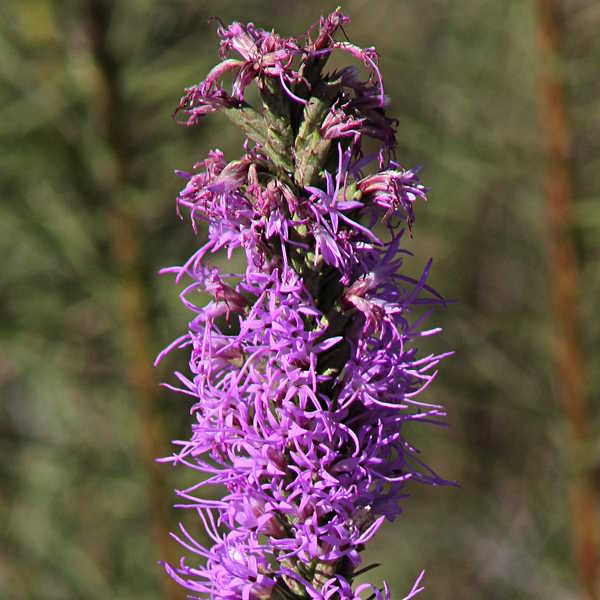
In addition, the flower heads mature at the top of the spike before the lower ones. This can be seen in the closeup of the flower spike above. Notice near the top of the spike, you can see withered flowers projecting from the green stem that joins the compound flower to the spike. You can also see a single floret with four petals open near the top, right of center. The long pink tube extending from the center is the top of the pistil, the female portion of the floret.
The flower spike of Gayfeather is reminiscent of the feather plumes used to decorate hats once upon a time; hence the name, Gayfeather. Personally, I think they look like a bottle brush. Their hot pink florets, tall flower spike, and narrow straight edged leaves are the characters that distinguish these plants from other wildflowers. They appear late in the year when everything else has gone brown and add vibrant color to an otherwise dull landscape.
Leave a Reply