We visited the University of Colorado’s Trial Garden when we were in Fort Collins, Colorado this summer and brought home some colorful images of the many different varieties of Petunias that were on display.
Petunia is a genus of South American members of Solanaceae, the Nightshade family which contains potatoes, tobacco, and the bell and chili peppers. The Petunia genus contains about 20 different species, but the petunias everyone is familiar with come from varieties derived from Petunia axillaris, a large white flowered plant, and Petunia integrifolia which produces purple blossoms. Since varieties are not distinct species their names do not follow the rules of the international system of biological nomenclature required of species. Instead, their names may reflect commercial trademarks.

This is a variety known as Crazytunia Frisky Purple. Notice the white strip in the centers of the wine colored petals. This trait varies among the different flowers pictured here to produce an eye pleasing variety of colors and shapes.
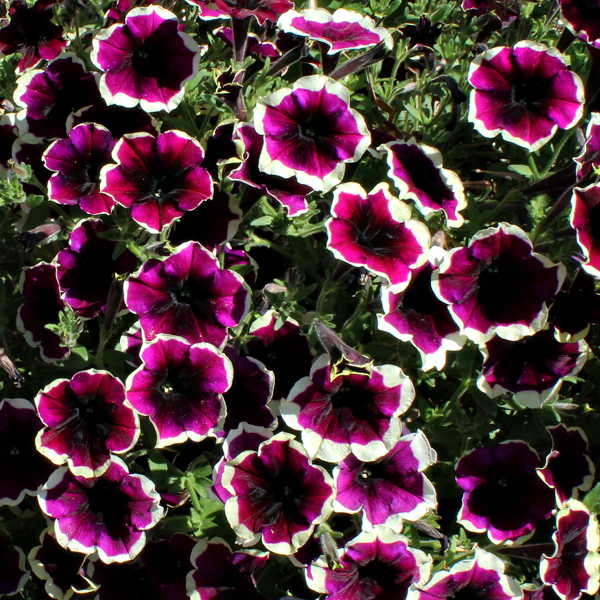
This image shows another Crazytunia variety called Goodnight Kisses. Here the breeder selected for white tipped petals instead of white centered petals. This gives the flowers a white-rimmed look.

Here is yet another Crazytunia variety called Moonstruck. Here the blooms are purple rimmed but their petals vary in the placement of white, cream, or yellowish petal centers. This gives a random effect to the blossoms in terms of color placement which provides a beautiful mixture of blooms and colors. I really liked this variety’s kaleidoscope of colors.

Here you can see a variety known as Constellation Gemini. The pale lavender flowers have tiny white spots on the petals giving a speckled effect. Notice the speckling occurs wherever the lavender is expressed in the flowers. I think it is interesting that there is variation in the amount of lavender and white on some of the flowers. It is a visual indication of the sometimes capricious nature of flower genes. We benefit from the beauty this creates.
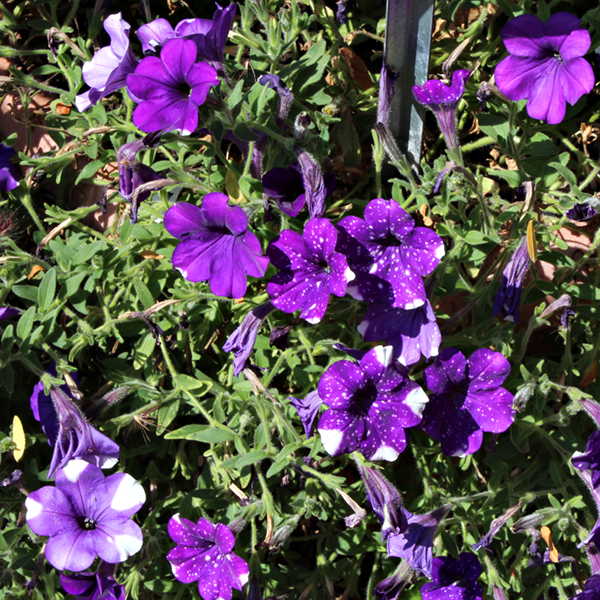
Here we have the variety called Headliner Night Sky. If you compare these to the previous image you can see that the speckle trait appears in this variety, too. The petals are a beautiful purple instead of lavender, and the white blotches on the petals seems more subdued than what was seen in the Constellation Gemini.
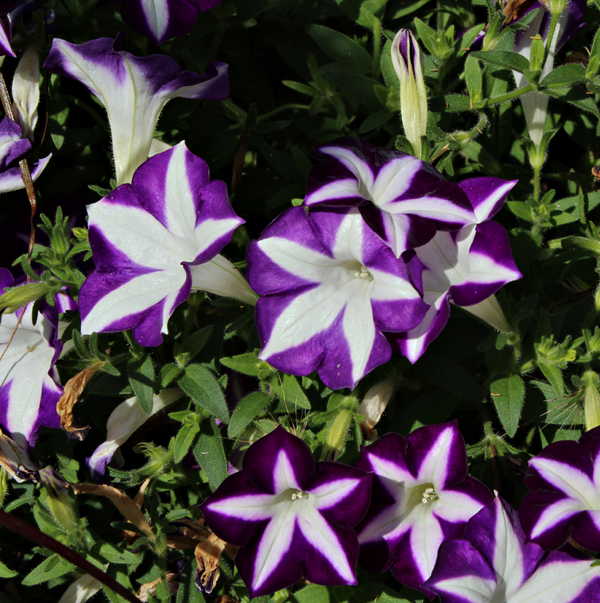
This one is called Blanket Blue Star. This is my favorite because of the crisp white star effect created on the flower by the white centered petals. The contrast between white and purple makes a stunning flower. This variety is a spreading plant that grows along the surface of the container to fill in the gaps between flowers so all you see is petunia. Lovely.
What you have witnessed here is the handiwork of plant breeders to produce plants of remarkable beauty from crossbreeding a white flowered species and a purple flowered species. Here, man is acting to control the reproduction of plants to produce plants with the characters he desires. The same process occurs in nature where nature selects the characters which best enable the individuals of the species to survive the environments in which they find themselves. We call that evolution. Look around you and you can see the end-products of 3.5 billion years of genetic variation and selection for survivors.
Leave a Reply