The family Anatidae contains the ducks, geese and swans. They are a large group of birds that most folks are familiar with because of domesticated members of the family. These birds are world wide in distribution and contain 5 subfamilies, 50 genera, and 160 species (Integrated Taxonomic Information System)
Blue-winged Teal, also known as Anas discors, are members of the subfamily Anatinae, the surface feeding ducks. They are sometimes known as Puddle, or dabbling ducks and they make their living on shallow ponds, rivers, lakes and marshes by swimming along the surface looking for food. They will dip their head and neck under the water to reach food, often times up-ending themselves. Only rarely, will they completely submerge. Thus, the term dabbling ducks.
Most of the members of the subfamily Anatinae are sexually dimorphic which means that males and females look different in terms of their morphology (physical characteristics). Males also have two sets of feathers, one which they wear during mating season and one which they wear during the rest of the year called the eclipse plumage. All of this complicates field identification as you might imagine.
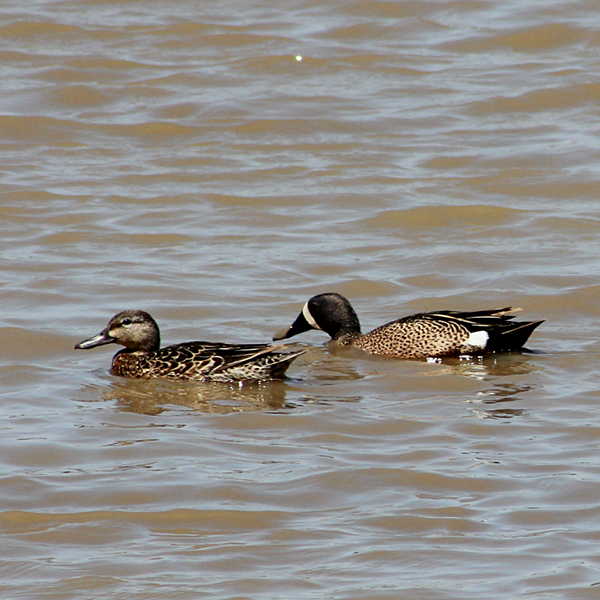
In the picture above, you see a female Blue-winged Teal on the left and a male on the right. The male is in his breeding plumage and is easily distinguished from other ducks by the white stripe between his black beak and his eyes. Note the dab of grayish mud on his beak tip. The brown and white mottling of the feathers along the side and the white patch just in front the dark tail feathers are also useful characters. The male’s head looks black in this photo but can appear very dark blue when the light and angle of reflection is right. Notice that the tips of their tails are out of the water which is characteristic of all members of this subfamily.
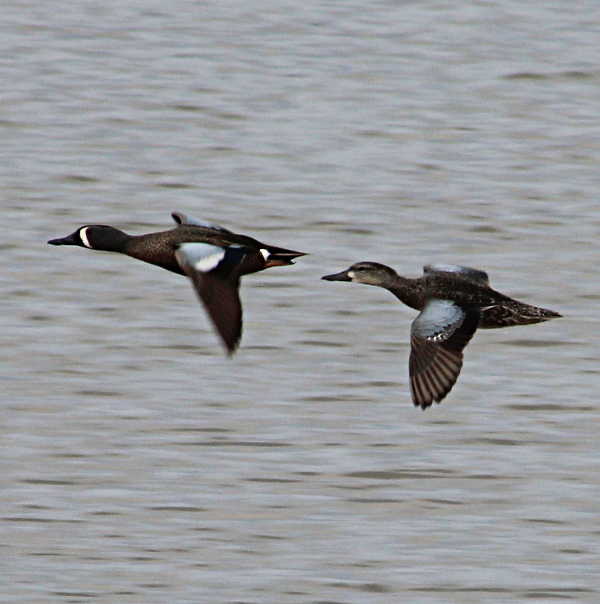
In the second image, you can see a male Blue-winged Teal on the left and a female on the right. His white crescent in front of the eye and white rump patch are clearly visible. Both ducks have large patches of grey-blue color on the upperside of each wing. In brighter light, this patch can appear almost white tinged with light blue. As you might have guessed, this species is named for this character.
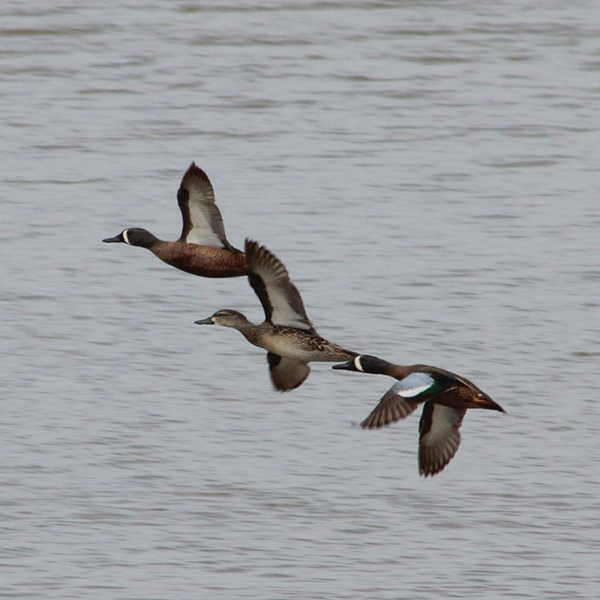
In the the third and last picture, two males are flying with a female between them. Note the colors under the wing in both sexes and notice the differences between breast and belly on males and females. Finally, most members of the subfamily Anatinae have a special group of feathers on the trailing edge of the upper wing feathers. This patch of feathers is referred to as the speculum which means a shiny or mirror-like surface. The feathers of the speculum in blue-winged teal are an irridescent green that you can see on the rightmost duck. In brighter light, the speculum appears as a shiny emerald green and is quite striking.
Blue-winged teal can be seen throughout most of the U.S. and Canada at different times of the year. They migrate through Texas on their way to Northern South America. Some of them over-winter in Texas, and sometimes they reproduce here too.
They are beautiful birds to see, and hard to approach without a blind or some kind of cover to conceal you. The ones I photographed in flight were spooked by me getting too close for their comfort. This is where field biologists learn about fight or flight distances.
If you love ducks like I do, you might like to read a book by Paul A. Johnsgard called Ducks, Geese, and Swans of the World. The 2010 Revised, electronic edition is available from University of Nebraska-Lincoln Libraries as a Portable Document Format (pdf) file downloadable for free. This is a thorough, solid reference with lots of ink illustrations and informative text. It will give some of you younger folk a taste of what scientific papers were like before the days of cheaply produced color photographs and digital downloads. Also, there are lots of other works by Dr. Johnsgard posted for free access. An education free for downloading. Thanks to Dr. Johnsgard and the University of Nebraska for making these available.
Leave a Reply