
Northern Shoveler ducks belong to the species Anas clypeata in the family Anatidae. The distinguishing feature of this species is the large spoon-shaped bill. The male in breeding plumage has a blackish head trimmed with iridescent green which is visible when the light is right. His bill is black and his feet are orange. Females have orange feet and orange bills. The female, as you can see, is brown and white mottled to make her hard to find by predators. Did you notice the difference in eye color?

In this image, you can see the reddish brown bellies of the 3 males, their white under-wings, their gray-blue upper wing patch, and their iridescent green specula on the trailing edges of the wings. These colorful markings and their long bills make it easy to identify these birds in flight.
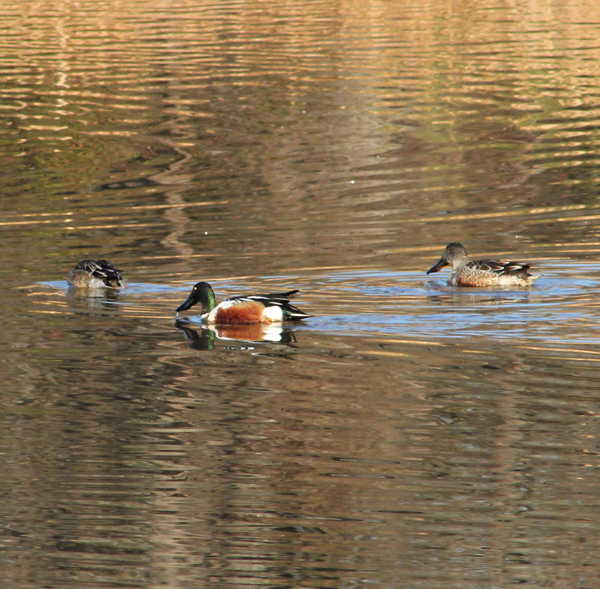
In this image, you can see 2 females and a male dabbling for their dinner. These ducks use their bills to filter food from the bottom mud of the wetlands where they live or visit. In this photo, these ducks were on open water adjacent to a marsh.

In the last image, you can see 2 males and a female shoveler busily sluicing water through their beaks they have filled with mud. They wash away the mud by opening and closing their beaks and the channels in the beak trap plant and small animals that they eat.
We get to see Shovelers in Texas during the winter when they migrate in from colder places to visit until spring. Beautiful ducks!
I rarely have seen this species in large groups, at most 4 to 10 individuals would travel around the places I look for waterfowl. They are much larger than the mallards which folks mistake them for. They are interesting to watch if you can get close enough. I shot these images with a 300mm lens from some distance away and I have enlarged portions of these images I used to make the images you see here. Someday, I will be able to afford longer lenses but they are usually heavy and require a tripod. I try to keep my gear light and mobile so I can move readily to capture something interesting.
Leave a Reply