
When we arrived home after a day out in early August 2017, my son called me into the backyard because he had spotted Horned lizards feeding near an anthill. He was doubly excited because he thought he had seen a momma and her babies.
When I got my act together, we were able to find and photograph this little fella. He is parked by a remnant of a Redstem Storksbill that I had mowed recently.
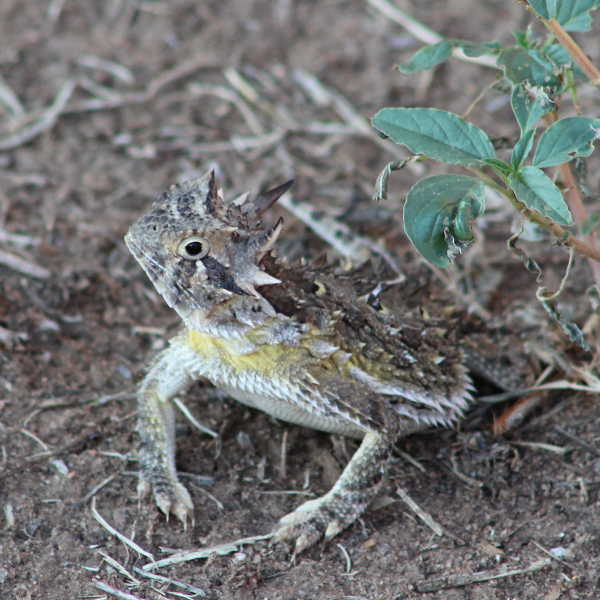
Notice the black eyestripe, it is diagnostic for Phrynosoma cornutum, the Texas Horned lizard (family Iguanidae). You can see more of these in another post here.

I put this image into the series because it shows our friend in the midst of some dried Bermuda grass stems. Note the size of the stems near its chest area. This will help you gauge the tiny size of the little baby you will see next.

In this image, you can see a young Texas Horned lizard. He is straddling a dried Bermuda grass stem like the one in the previous image. This little guy is not much bigger than a grasshopper.

Here is a closeup from the same image. You can see the beginnings of the black eyestripe characteristic of the species. Notice that all the spikes and horns haven’t reached the adult size. In the hip region you can see a couple of whitish chevrons that are becoming visible. Compare this guy to the images of the adult and you will see that this youngster has a way to go developmentally. Plus, he is about one fifth the size of the adult. He’s going to have to eat a lot of ants to grow all the way up.
Leave a Reply