
In my backyard, I am lucky enough to have a yearly visitor in the form of a Texas Horned Lizard, Phrynosoma cornutum. This little fella shows up periodically to eat the red harvester ants that appear in various places in the yard. We let these ants alone because they are usually no problem unless you stand in the middle of their mounds and cause the colony to defend itself. They are part of the local ecosystem and they feed the “horny toads”.
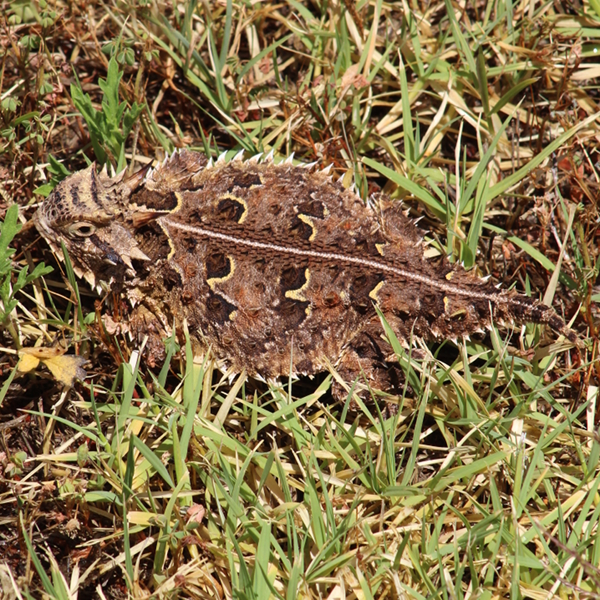
Horned lizards belong to the family Iguandidae which is evident when you look at the shape of the head and muzzle on these guys. There are at least 14 species of horned lizard in the genus Phrynosoma in the US and Canada. Notice the dark stripes radiating from the eye and the two large horns on the back of the head; these are diagnostic for P. cornutum. Also, they have a light stripe down the center of their back which helps identify them at a distance.

Texas Horned lizards have spines all over their body and their body is flattened. The abdomen of this individual was about the diameter of a golf-ball. Their shape and their spininess makes them hard for predators to swallow. W. M. Winton in Copeia No. 36 (10-24-1916) “Habits and Behavior of the Texas Horned Lizard, Phrynosoma cornutum, Harlan.I” pp. 81-84, said “When attacked, the lizard puffs itself out into an almost flat shape and tucks the head down, exposing the horns, and waits for the enemy.” Any enemy would be assured of a mouthful of thorns by attempting to eat one on of these “horny toads”. I recently observed this behavior when I was walking through the yard and not paying too close attention. I nearly stepped on one of the little guys and he had assumed this “prickly” defensive posture. We both recovered from our fright and went our separate ways. Not paying adequate attention to your surroundings in my part of the world can lead to rattlesnake bite, so you can understand my use of the term fright for the above. Needless to say, I am more careful.
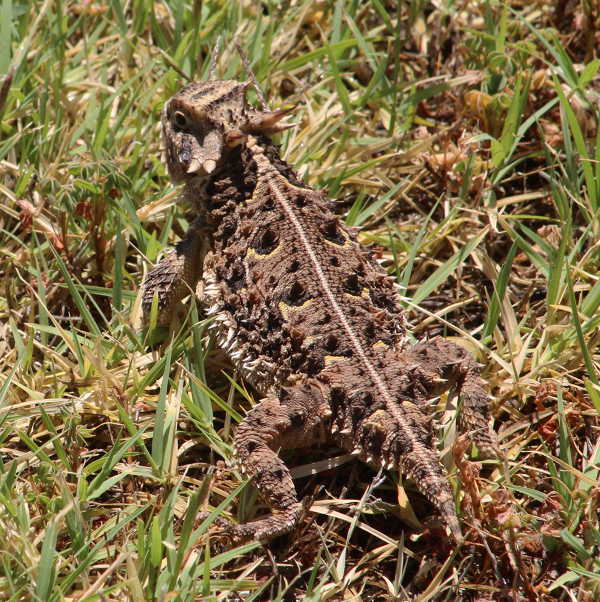
Because of fire ants, pesticides, and habitat reduction, Texas Horned lizards have become a threatened species and it is illegal to possess, transport, or capture them without a special permit.
I count myself lucky that there seems to be adequate food and habitat for these little guys around our place. They struggle when traveling through the grass of the lawn, but they seem to manage. They prefer more open sandy country with plenty of ants. They are a visual treat when I can see them and I hope they thrive and reproduce. I am glad they haven’t become extinct and that my state is taking steps to make sure they don’t.
Leave a Reply